Proton therapy is a fabulous advanced cancer treatment technic but its advantages assume that the beam is homogeneous over the zone to be irradiated, and even as much important to control it position with a very high accuracy. Therefore, it is systematically carefully checked prior to clinical irradiation either by using ionization chamber devices, which are complex, expensive and limited in resolution. Another possible method consists of scanning a silicon diode across the area but this approach poses four problems. First, any beam intensity variation during the scan is interpreted as non-uniformity. Second, correcting any non-uniformity with a single pixel detector requires iterative scans, it takes time, and does not easily converge. Third, the light must be turned off as Si is sensitive to visible light. Fourth, the Si diode degrades with irradiation time (dose). Having a low cost imaging device that measures the beam profile in one shot, in the day light or room light, and with a radiation resistant technology solves all these issues. Moreover, reducing the calibration procedure duration from at least 30 minutes, for current technologies, down to only few minutes will allow to significantly increase the number of irradiations per day, and thus the number of patients.
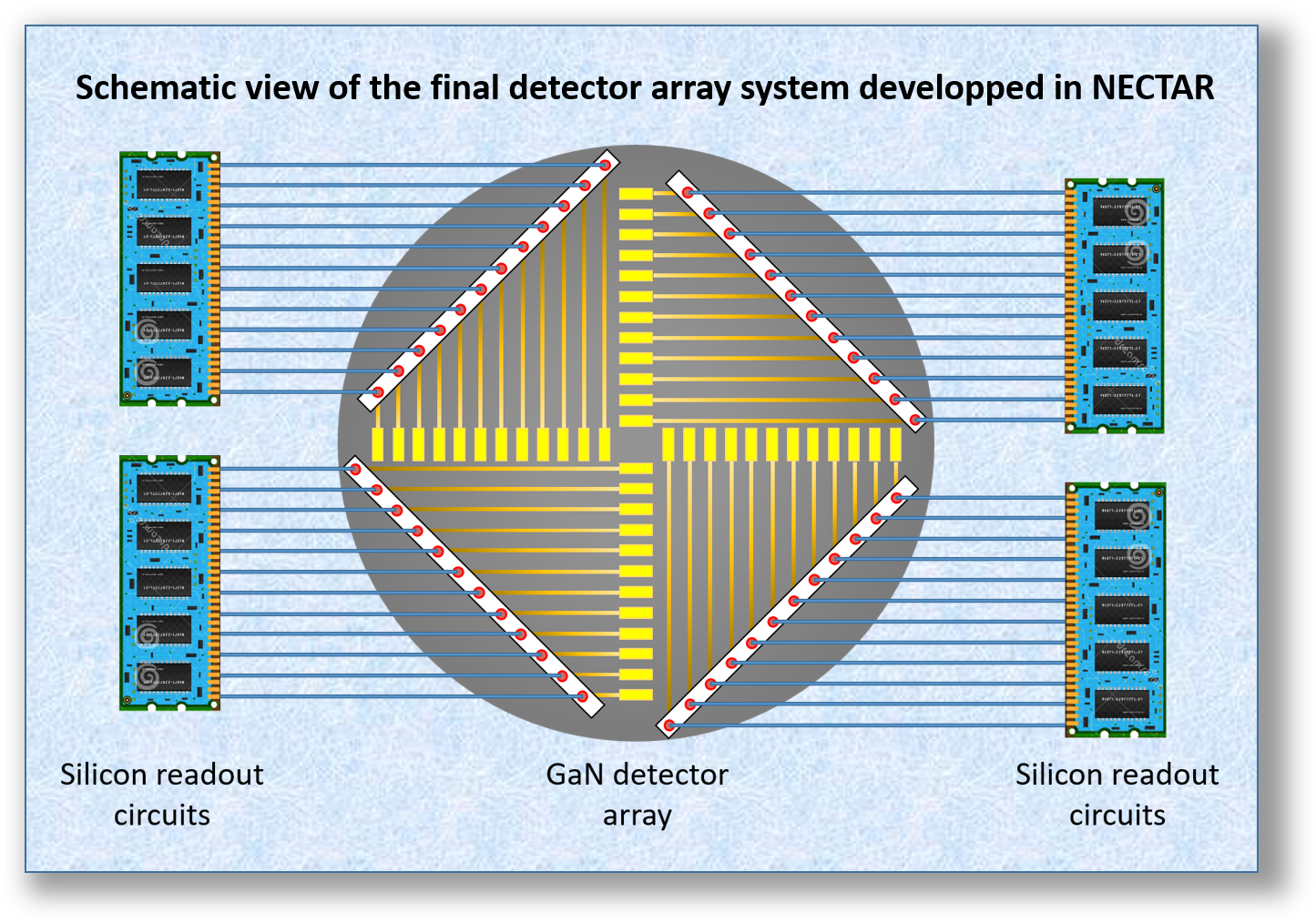
NECTAR project aims at improving the quality assurance clinical protocols by developing a complete system to calibrate proton beam before irradiation treatment. For the first time, we will implement a new approach based on robust gallium nitride (GaN) semiconductor that will allow surpassing by far the current technologies. Indeed, we propose to fabricate detector arrays that can instantly measure the proton beam on a 5x5cm2 window and with a resolution of 100 microns. A proof of concept with single elements has already been demonstrated and we expect now to develop a 2D array that will be qualified on the cyclotron line Medicyc at Centre Antoine Lacassagne hospital in Nice.